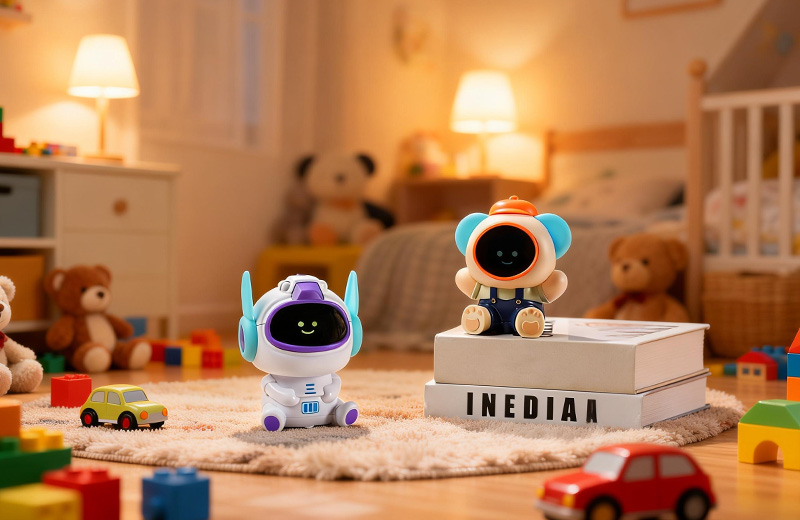


One represents the past hundred years of childhood imagination.
The other hints at the next hundred.
But the transition from plush toys to AI-enabled toys isn’t a simple upgrade from “soft” to “smart.” It’s a shift in how children build emotional security, learn through play, and form early identities in an increasingly digital world.
This is the story of how these two seemingly separate worlds are beginning to overlap—and why the future of play might depend on the balance between the two.
Why Plush Toys Still Matter—More Than Ever
Psychologists have long known that a plush toy is rarely “just” an object.
It absorbs stories. It holds fears. It becomes a proxy for a child’s emotional experiments.
A plush toy:
Never corrects a child.
Never gets tired.
Never leaves first.
Has no agenda, no right answers, and no performance metrics.
Its superpower is its simplicity.
In moments of stress—moving homes, sleeping alone, or navigating early social life—plush toys become transitional companions that help children regulate emotion through tactile comfort. They are predictable in a world that changes too quickly for a young mind.
Even as toy stores modernize, plush toys sales remain steady globally. Why?
Because comfort doesn’t go out of style.
But predictability is also a limitation. Plush toys don’t respond. They don’t teach. They don’t remember the child’s favorite joke or adapt to their curiosity. And as parents increasingly worry about “passive screen time,” the pressure is on the industry to rethink how learning and emotional support can happen without screens.
This is where AI toys enter the picture.
AI Toys Are Not Replacing Plush—They’re Answering New Questions
AI toys emerged not to replace the softness of childhood, but to solve a new set of problems:
How do you keep a child engaged without handing them a smartphone?
How do you support language development when parents are busy?
How do you encourage curiosity in ways that feel natural rather than forced?
Unlike plush toys, AI toys can:
Hold dynamic conversations
Recognize objects
Personalize content
Encourage daily habits
Remember preferences
Introduce languages, stories, and logic
When an AI toy says, “I remember you liked dinosaurs yesterday—want to learn about another one?”
—it's not just entertainment. It’s scaffolding a child’s cognitive growth.
And for many families, AI toys are becoming a middle ground between “I don’t want my child on a tablet” and “I still want them to learn and interact with something intelligent.”
But this intelligence comes with new responsibilities.
The Emotional Gap: What AI Still Can’t Replace
Despite their capabilities, AI toys cannot replicate a fundamental part of human attachment: warmth.
A plush toy doesn’t misunderstand a child.
It doesn’t glitch.
It doesn’t store data.
It doesn’t require updates.
Its silence is, paradoxically, what makes it emotionally safe.
One parent described the difference perfectly:
“The plush toy is the child’s listener.
The AI toy is the child’s sparring partner.”
Both roles are important—but they’re not interchangeable.
The Future Emerges: The Fusion of Plush and AI
The most interesting trend today isn’t the competition between plush toys and AI toys—it's their convergence.
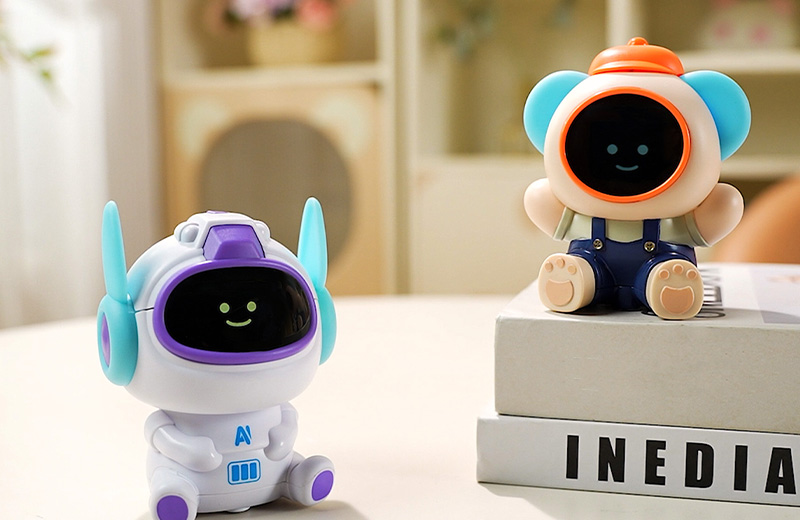
Manufacturers around the world are experimenting with embedding intelligence into soft, familiar forms, trying to merge:
the emotional reliability of plush
the adaptive intelligence of AI
This hybrid approach aims to preserve the comforting presence of a plush toy while layering on meaningful learning interactions.
Notably, companies like INFUNITY, a former traditional toy manufacturer with 20+ years of experience, are pioneering this direction. Coming from a world where tactile experience and child psychology matter deeply, they are now integrating AI into designs without losing the warmth that children intuitively seek. Their philosophy is simple: technology should never replace comfort—it should enhance imagination.

This generation of toys doesn’t ask children to choose between softness and intelligence.
It asks, “Why not both?”
What AI Toys Teach Us About the Next Era of Childhood
A child growing up in 2030 is navigating a world fundamentally different from the one their parents knew.
Their first “search engine” may not be a phone. It may be a toy that speaks back.
This changes childhood in several ways:
1. Learning becomes ambient.
Knowledge isn’t requested—it emerges through conversation and curiosity.
2. Identity forms through co-creation.
The toy reacts to the child, giving them a sense of agency and control.
3. Play becomes personalized.
Two children with the same AI toy will have different experiences because the toy learns from them.
4. Playtime becomes screenless again.
Technology quietly embeds itself into physical play rather than replacing it.
And yet, through all this change, plush toys remain the anchor—silent, soft, grounding. They keep play human.
A New Kind of Dual Childhood
Children today will likely grow up with:
a plush toy they sleep with
an AI toy they explore with
One nurtures emotional security.
The other builds cognitive curiosity.
Together, they create a dual ecosystem of comfort + intelligence, a pairing that mirrors the balance adults also seek in modern life: emotional grounding and intellectual stimulation.
This isn’t a transition from old to new—it’s an expansion of what childhood can include.
The toy industry is not witnessing a replacement.
It is witnessing a partnership.
The Long Arc Forward
As AI toys evolve—better natural language, stronger memory, deeper personalization—the question for the future won’t be whether they can replace plush toys.
The real question will be:
How do we design toys that help children stay emotionally whole in an increasingly intelligent world?
If we get that right, plush toys and AI toys won’t compete.
They will coexist as two halves of the same childhood—one soft, one smart, both essential.
 Recommended for You